

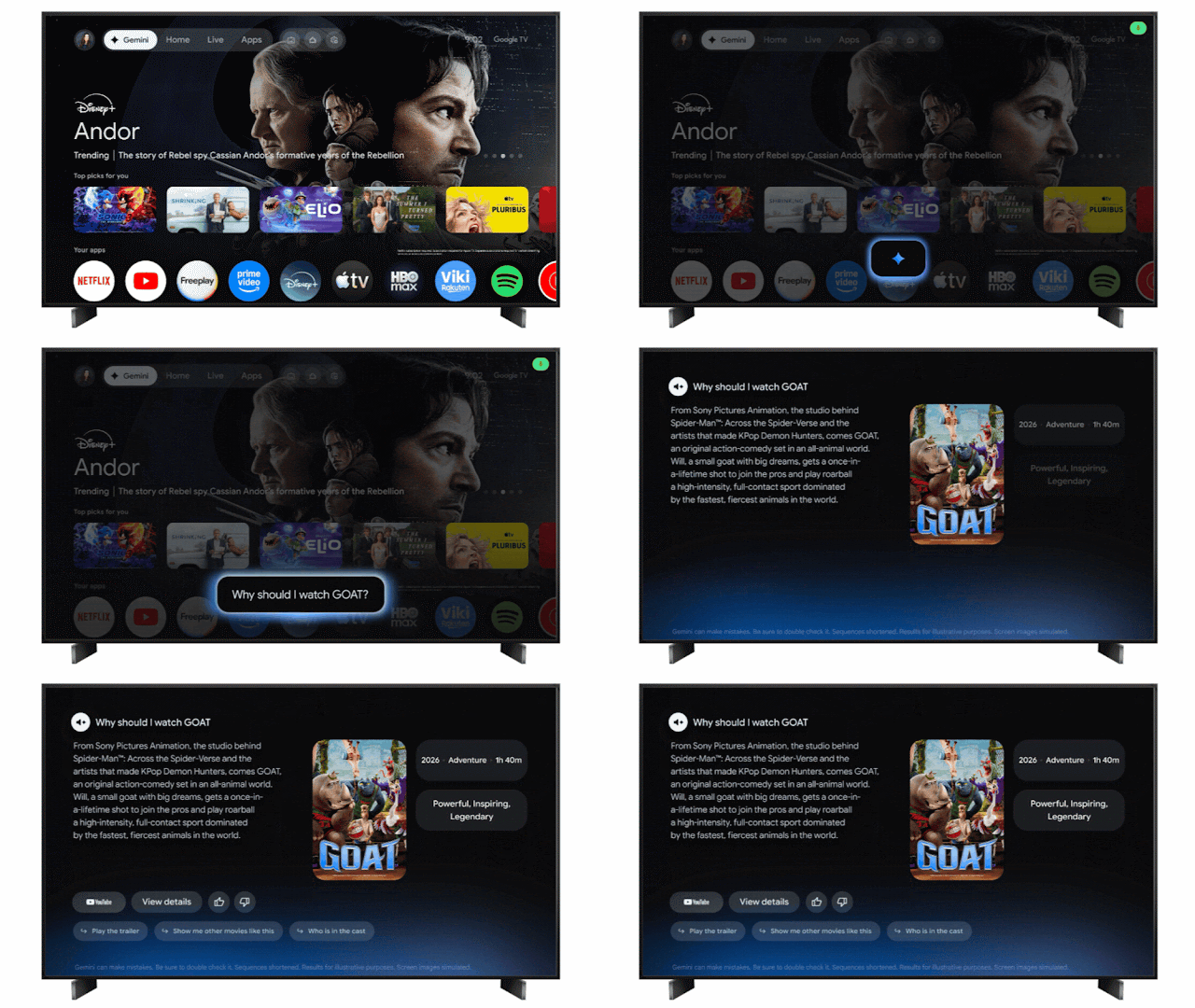
The landscape of home entertainment is undergoing a profound transformation. With more than 300 million monthly active devices currently powering Google TV and Android TV, the living room has solidified its position as a primary gateway for digital consumption. As streaming platforms compete for a finite amount of user attention, Google is aggressively evolving its ecosystem to ensure developers can meet the shifting demands of the audience.
In a series of strategic announcements tied to Google I/O 2026, the tech giant has unveiled a suite of new developer tools and platform features. These updates are designed to solve two core challenges: increasing content discoverability through generative AI and adapting to the new era of motion-controlled, pointer-based navigation.
Main Facts: A New Paradigm for TV Development
The recent update marks a departure from traditional "remote-only" TV interfaces. The core components of the announcement include:
- Gemini Integration: The expansion of Google’s AI assistant on the platform, which now acts as a sophisticated discovery engine by parsing app metadata to surface relevant content.
- Pointer Remote Support: A significant shift in how users interact with their television, moving away from static D-pad navigation toward motion-based pointer inputs.
- Engage SDK Mandate: A push toward the Engage SDK (formerly the Video Discovery API), which is set to replace the legacy Watch Next API by late 2027.
These updates represent a holistic effort by Google to ensure that the living room experience remains fluid, intuitive, and highly personalized. For developers, these changes necessitate an immediate audit of existing UI/UX pipelines to ensure compatibility with a rapidly diversifying range of input methods and recommendation algorithms.
Chronology: The Evolution of the Android TV Ecosystem
To understand the weight of these updates, one must look at the timeline of Google’s TV strategy:

- The Early Years: Android TV established a standardized, lean-back interface, prioritizing simplicity and reliable D-pad navigation.
- 2024–2025: The introduction of "Watch Next" APIs helped bridge the gap between fragmented apps, allowing users to resume content from a central dashboard. During this period, Google began integrating AI-driven search capabilities.
- March 2026: Google rolled out significant enhancements to the Gemini integration, enabling the AI to provide multi-modal responses (text, video, and imagery) directly on the TV interface.
- May 2026 (Google I/O): Google officially signaled the sunsetting of the legacy Watch Next API, setting a hard deadline for the transition to the Engage SDK by the second half of 2027. Concurrently, the platform began formalizing support for pointer-based remotes, signaling the end of the D-pad monopoly.
Supporting Data: Why the Living Room Matters
The scale of Google’s platform is the primary driver behind these changes. With 300 million monthly active devices, the Google TV ecosystem represents one of the largest hardware footprints in the media industry.
According to internal platform metrics, user engagement correlates heavily with the speed of discovery. When users can navigate through a "Continue Watching" carousel or receive AI-powered recommendations based on their viewing history, session times increase by an average of 15–20%. By forcing the transition to the Engage SDK, Google is betting that standardized metadata and more robust recommendation signals will drive higher retention rates across all third-party streaming apps.
Furthermore, the introduction of pointer remotes is a direct response to the "content-heavy" nature of modern streaming apps. As libraries grow, traditional scrolling via arrow keys becomes tedious. Motion-controlled navigation offers a faster, more ergonomic alternative, which Google anticipates will lead to deeper exploration of app menus that were previously buried in multi-layer UI structures.
Official Responses and Strategic Vision
Google’s engineering team has been clear about the intent behind these changes. The goal is to move beyond passive content consumption. By leveraging Gemini, Google is transforming the TV into an interactive assistant.
"Gemini is no longer just a voice search tool; it is a discovery engine," a spokesperson noted during the developer briefing. "By tapping into the metadata provided by our streaming partners, we are able to bridge the gap between a user’s vague inquiry—like ‘show me a tense thriller from the 90s’—and the exact application where that content resides."

Regarding the shift in input modality, Google emphasized that the move toward pointer remotes is about "spatializing" the interface. "We are bringing the precision of a touch-based experience to the ten-foot UI," the team stated. "While the D-pad will remain a staple, the addition of pointer support provides a significant boost to usability for complex, dense applications."
Implications: What Developers Need to Do Now
The transition to this new era of Google TV requires proactive technical adjustments. Developers cannot afford to be passive, as the platform is shifting toward a more "touch-like" environment.
1. Adapting the UI Library
The most immediate task for developers is to ensure their application supports hover states and pointer-based interactions. While this sounds complex, the adoption of Jetpack Compose is the recommended path forward. Most core Jetpack components are already designed to handle multi-modal inputs, reducing the burden on developers to write custom interaction logic.
2. Testing for "Ten-Foot" Precision
One of the most critical warnings from Google is the difference between mouse precision and remote precision. Users sitting ten feet away from a screen will not have the same fine motor control as someone using a desktop mouse. Developers must design for this:
- Larger Hit Targets: UI elements must be larger to account for "jittery" pointer movements.
- Robust Hover States: Visual feedback must be immediate so that users know exactly which element they are hovering over, even if their aim is slightly off.
3. Manifest Declarations
To ensure that apps appear correctly on devices that support these new remotes, developers must update their AndroidManifest.xml files. Specifically, including the android.software.leanback.supports_touch metadata tag is essential. This signals to the Google Play Store that the app is optimized for this new interaction, ensuring that users with modern pointer-capable remotes have a seamless experience.

4. The Engage SDK Transition
The sunsetting of the legacy Watch Next API is perhaps the most significant structural change. Developers currently relying on the old API must prioritize migrating to the Engage SDK. This SDK is not merely a replacement; it is an upgrade that provides better tools for managing entitlements and recommendations. Given the 2027 deadline, teams should treat this as a multi-quarter project, beginning with an audit of their current implementation.
Conclusion: The Future of Interactive Television
The living room is no longer just a place for passive viewing; it is an interactive hub. By integrating generative AI, providing motion-controlled navigation, and standardizing engagement metrics through the Engage SDK, Google is effectively modernizing the television experience to match the expectations of a mobile-first generation.
For developers and streaming services, these updates are not merely "new features"—they are requirements for relevance in a crowded market. The companies that embrace these changes early—by optimizing their UI for pointer input and adopting the Engage SDK—will be the ones that capture the most valuable real estate in the home: the user’s attention.
As we look toward the 2027 deadline for legacy API sunsetting, the message from Google is clear: the future of television is intelligent, interactive, and increasingly reliant on the developer’s ability to build fluid, high-performance interfaces. For those willing to adapt, the rewards—measured in discovery, retention, and growth—will be substantial.